
Five Days of Mountain Biking in Deer Valley

The Road to Deer Valley
This trip was never meant to be a photography project or another film shoot. Of course, I brought a camera with me - at this point, I’m not sure I know how to travel without one - but photography wasn’t the reason we came.
This time, it was all about riding.
Five days in the mountains around Park City, Utah. Five days to explore Deer Valley, ride new trails, spend time together, and see where the mountains would take us.
We left the Bay Area early in the morning, around 5:30. Ahead of us was a full day on the road - across California, Nevada, and finally into Utah. Mile after mile, the landscape kept changing. Much of Nevada already sits at a considerable elevation, and as we continued toward Park City, the road gradually carried us higher into the mountains.
By the time we arrived, it was almost 7 p.m. local time.
The first thing that struck me was how different everything felt from California. Green mountain slopes, beautiful stands of deciduous trees, wide-open views - and trails seemingly running everywhere through the landscape.
The elevation made itself known pretty quickly too. I had a headache that first evening. Nothing serious, and it eased after a shower, but it was a clear reminder that we were going to spend the next several days riding much higher than I normally do.
There was no complicated strategy for the trip.
We wanted to ride.
Start easier, get a feel for unfamiliar terrain, and gradually work our way toward faster, steeper, and more technical trails. No need to chase numbers or turn every day into a test. We had five days ahead of us, and there seemed to be more than enough mountain to explore.
At least, that was the idea when we arrived.
The next morning, we headed to Deer Valley for our first day in the bike park.

Day 1 - Getting to Know the Mountain
The first day at Deer Valley turned out to be a little different from what I had imagined after watching videos and studying trail maps.
Not better. Not worse.
Just real.
I wasn’t in a hurry that morning. New bike park, unfamiliar trails, different dirt, and a much higher elevation than I normally ride at home.
It had rained before we arrived, and I would estimate the grip at maybe 70–80 percent of what I would ideally want. In some places the dirt held beautifully; in others it was a good reminder that this was our first day on an unfamiliar mountain. Every now and then a few drops of rain would fall, but it never developed into actual rain.
In the end, the weather was almost perfect for riding. It wasn’t hot, clouds hung below us in places, the sun occasionally broke through, and there were surprisingly few people on the trails.
That gave us exactly what I wanted for the first day: time to look, read the terrain, remember lines, and gradually increase the speed.
And gradually was the important part.
I started the morning leaving plenty in reserve. With every descent, though, I began to understand the mountain a little better - where I could release the brakes, how much grip the dirt offered, how the turns were shaped, and what the local rocks and roots looked and felt like under the bike.
By the middle of the day, I was already beginning to push a little harder.
We spent almost the entire day exploring one side of the mountain and covered a lot of ground: Holy Roller, Tidal Wave, Twist & Shout, Aspen Slalom, Freestyle, Dog Pound, Thieves Forest, Fire Swamp, Naildriver, Super G, and Tsunami. We rode some of the lines more than once.
Later in the day, on our way back, we finally dropped into Regulator.
That one immediately gave me a very particular feeling:
I could go fast here without even doing a warm-up run.
But I didn’t.
There would be time for that later. The first day didn’t need to be the fastest one.
Throughout the entire day, I can remember only one feature that I consciously decided not to ride - a wooden bridge/drop on one of the lines starting around the Fire Swamp area. Everything else we encountered on the routes we chose that day, I rode.
Another surprise was the trail grading.
Before the trip, seeing black and double black on the map naturally created certain expectations. Once I was actually on the mountain, some of those ratings felt a little generous to me.
That doesn’t mean the trails were easy, and trail ratings always need to be understood in their local context. But after the first day, it was already clear that much of what had looked intimidating on the map was readable and completely rideable once I could actually see the terrain in front of me.
But difficulty wasn’t what stayed with me most.

Deer Valley Looks Different
The landscape here has a completely different character from what I’m used to riding in California.
Green grass covers the mountainsides. Light-colored deciduous trees fill the forests - at first I caught myself thinking they looked like birches, although they are much closer to aspens. Open slopes alternate with sections of forest, and from higher on the mountain the views stretch far beyond the trails themselves.
And the trails are remarkably well built.
You can see how much work has gone into them: the lines, turns, transitions, jumps, and wooden features all feel intentional. They don’t simply look like paths cut down a mountain. There is a sense that somebody thought carefully about how a bike should move through this terrain.
By the end of the day, we had covered about 37.7 miles (61 km), with more than four hours of actual moving time and a maximum elevation of roughly 9,300 feet (2,830 m).
But the numbers weren’t really the point.
The first day was about meeting the mountain.
Not proving anything to it.
Not checking trails off a list.
Not chasing a time.
Just looking. Feeling the grip. Understanding the lines. Learning when to trust the bike - and myself - in a completely new place.
By the middle of the day, that trust had already started to come.
For a first day?
Good. Very good.
Day 2 - A Different Side of Deer Valley
After our first full day in the bike park, Day 2 could probably be called a recovery ride.
Although “recovery” might not be entirely accurate.
Our ride actually started at a bus station. We loaded the bikes onto the Purple Line and took it all the way to the last stop at Montage Deer Valley, where we expected to begin the climb toward our route.
As it turned out, there wasn’t much searching to do. One switchback up the pavement, and almost immediately we were on Mid Mountain.

My first impression was simple:
It felt almost too perfect.
The climbing was mostly gradual. The dirt was excellent. There were occasional roots, even fewer rocks, and only a handful of short, steeper pitches. Coming from the trails I normally ride back home, I still wasn’t used to something this polished.
One of those few steeper sections did manage to catch one of us off guard. He lost his footing and went surprisingly far down the slope. Fortunately, the bushes and branches broke his fall, and he was fine.
From there, Mid Mountain kept changing character.
We would cross wide-open ski slopes and then disappear back into the trees. A little later, another open section. Then forest again. Sometimes the trail allowed us to carry some speed; elsewhere it was simply a matter of settling into the pedals and continuing across the mountain.
Every now and then, other trails appeared from above, dropping through the trees and intersecting our route.
Some of them looked very interesting.
We noticed them. We remembered them.
But they weren’t part of today’s plan.
Eventually, we transitioned onto Spiro.
And this, at least for me, was where things started getting more interesting.
The speed came up. The trail invited me to let the bike run, and little by little, I did. I wouldn’t say I rode it particularly fast - it was still my first time on it - but one thought appeared almost immediately:
Come back a second time, and this could be fast.
It was fun.
Then came Seldom Seen, probably my favorite part of the day.
It was quicker, livelier, and much closer to the kind of riding I naturally gravitate toward.
Along the way, we crossed several steeper trails dropping through the trees. Those were a completely different story - and much closer to what I usually love most. A few sections even reminded me of riding back home around UCSC: a trail suddenly appears between the trees, drops sharply away, and immediately makes you wonder where it goes.
I wanted to turn onto some of them.
But not today.
We had a route planned, and we decided to stay with it.
I don’t regret that at all.
The entire ride had this remarkably clean, almost manicured character - smooth, flowing trail interrupted by just enough roots, rocks, and technical details to keep it interesting.
That is probably why I kept thinking of it as a recovery ride.
By the end, we had covered 12.75 miles with 883 feet of climbing, with a little over an hour and a half of actual moving time.
Not a huge effort.
Not a race.
Not an attempt to prove anything.
Just a very good ride through some extraordinary mountain scenery.
There was, however, one more participant in the trip that I began to notice that day:
the altitude.
It wasn’t stopping me from riding, and it wasn’t anything dramatic. But during some of the climbing, my body quietly reminded me that we weren’t back home and that we were spending our days at considerably higher elevations than usual.
Otherwise, it was almost the perfect second day.
The day before had been the bike park - speed, jumps, rocks, and technical lines.
Today was forest, mountains, pedals, and a long trail traversing the slopes.
Completely different riding.
And maybe that was exactly what we needed.
Day 3 - When the Black Trails Finally Felt Black
I didn’t feel particularly good that morning.
I woke up with a headache and nausea. A couple of painkillers helped with the headache, but the nausea stayed with me for much longer and didn’t completely disappear until sometime after 2 p.m.
Still, we arrived at Deer Valley early. By the time we picked up our tickets, changed, and got the bikes ready, the lifts were beginning to run.
One member of our group headed off on a completely different ride for the day, while the three of us stayed in the park and decided to explore the other side of the mountain.

We started with Ripple, a green trail that seemed perfect for warming up.
It was long and surprisingly rough in places, almost as if it didn’t see nearly as much traffic as some of the more popular trails. But the views were beautiful, the descent was long enough to wake up the body, and for the first run of the morning it did exactly what we needed.
Then we rode Regulator twice.
That was where my condition started showing.
I made several mistakes on the jumps, mostly being late with the takeoff. It’s a very particular and unpleasant feeling: you know immediately that your timing was slightly wrong, and the bike lets you know too.
Both runs ended with me feeling almost completely drained. It wasn’t that I couldn’t continue. I simply didn’t have the energy to keep pushing the bike the way I normally would all the way to the bottom.
Of course, I could have relaxed and simply rolled down.
But that isn’t really how I ride.
Enough blue trails.
It was time for black.
Devo
Roman’s fingers had started bothering him, so he decided to take a break. Boris and I continued onto Devo.
And finally, things became interesting in a different way.
For the first time during this trip, I found myself on a black trail where parts of it actually felt black. There were sections that required some thought - not simply pointing the bike downhill, but reading what was ahead and deciding how I wanted to get through it.
Later, Alexei rejoined us and we rode Devo again, this time sending him ahead so we could get some video.
While trying to film him through one of the turns, I became a little too interested in the camera and ended up gently putting myself on the ground.
Nothing serious.
Just a reminder that riding and filming at the same time is a skill of its own.
We then took the more difficult section of Devo and moved onto Old School.
Old School left me slightly confused. The line felt unusually straight, at times running almost through the backyards of the homes along the trail, and I couldn’t quite understand the black rating. Compared with what we had just ridden, I didn’t find much there that felt particularly difficult.

Then came Undertow.
And that was completely different.
Undertow - The Faster It Gets, the Better It Gets
I dropped into Undertow for the first time without doing a reconnaissance run.
And I let it go.
Not blindly, but as fast as I was comfortable riding an unfamiliar trail.
I loved it.
Undertow is one of those trails that changes character with speed. Lines begin to connect differently. Features that seem ordinary at a slower pace suddenly make sense. The rhythm changes, and the trail starts asking you to keep the momentum instead of constantly rebuilding it.
It’s also long enough that by the bottom I could feel the effort.
But I kept pushing all the way down.
It almost felt like a race run - not because I was racing anyone, but because once I committed to the pace, I didn’t want to give it back.
Buttercup
We had passed Buttercup several times earlier in the day.
Eventually, it was time.
Double black.
And this one finally lived up to the label.
Immediately.
Steep terrain. Trees. Rocks. Loose dirt - noticeably drier than most of what we had ridden that day.
And suddenly I had a very familiar feeling:
We’re almost back home in Santa Cruz.
This was much closer to the kind of terrain I naturally enjoy.
In the lower part, a log briefly confused the line. At first glance it looked as if it divided the trail and forced a choice.
It didn’t.
But by then I already had some speed, the dirt was loose, the grip wasn’t particularly generous, and...
I was lying on my side.
Nothing dramatic. A surprisingly soft and comfortable landing.
Getting started again was actually harder than falling because the slope was genuinely steep.
The second section of Buttercup entered another patch of trees. The dirt remained loose, but now roots appeared, including natural root steps.
I loved it.
This was exactly the kind of riding I had been looking for.
The Thieves Forest We Hadn't Seen
Wind had been with us throughout the day, strong enough that one of the lifts we had used on our first park day was being closed intermittently.
Eventually, it reopened.
We decided to go all the way to the top, ride something from there, and then finish the day with one last descent.
And that was when we discovered something rather funny.
On our first day, we thought we had ridden Thieves Forest.
Apparently, we hadn't really seen Thieves Forest at all.
This time we found the main line.
And suddenly the rating made sense.
The views were spectacular, but so was the trail itself: a couple of drops, rock ridges, roots, steep sections, loose rocks and constantly changing traction.
After seeing the landings, I knew I would probably ride the drops on another run. They looked good.
But not this time.
The rest of the trail was enough.
This was finally terrain that demanded attention from beginning to end. The bike was constantly moving underneath me, the surface kept changing, and the line required actual decisions.
After the full Thieves Forest, quite a few of the trails we had ridden earlier suddenly seemed a little less significant.
At that point, it was easily one of my favorite discoveries in Deer Valley.
We had time for one more descent.
There wasn't much discussion about which one.
Undertow. Again.
One Mistake
By then I felt considerably better than I had that morning. The headache was gone. The nausea was gone.
There was some fatigue from the day, but I wanted another fast run.
The upper section was a little loose. Nothing particularly concerning, but enough that it needed to stay somewhere in the back of my mind.
Then the speed began to build.
I was riding faster than on my first Undertow run.
In the middle of the trail came a sequence of rollers.
With each one, my speed increased slightly, and with each one my landing point moved farther forward.
Two rollers before the crash, I already knew what was happening.
I was making a mistake.
My speed was beginning to exceed the trajectory I had chosen.
But the speed felt good.
One more roller.
The landing moved farther forward.
And then there simply wasn't enough downslope left for the next landing.
I cleared it and landed almost directly into the uphill face of the following roller.
The suspension compressed hard.
And the bike and the trail immediately answered my mistake.
Catapult.
The ground was hard.
I hit it hard too.
I was back on my feet almost immediately.
There was no mystery about what had happened and nobody else to blame. I had understood the mistake before I crashed.
And, once again, it was my right shoulder - the same shoulder that had already taken two serious impacts nine and ten years earlier. Without that history, this crash might have ended with nothing more than some road rash. This time, I knew I would be feeling it.
I picked up the bike.
Everything still worked.
So I continued.
And before long, I was building speed again.
The second half of the remaining descent was physically much harder. The day was already in my legs, and now every rough section came with a reminder from the shoulder.
But I rode it to the bottom.

That was Day 3.
I had started the morning feeling sick and wondering how much riding I would have in me.
By the afternoon, we had found some of the most interesting terrain of the trip so far.
And I finished the day on the ground because of a mistake I had actually recognized before I made it.
Sometimes knowing exactly what is going wrong still isn't enough to stop it.
But it certainly gives you something to think about before the next run.
Day 4 - Earning the Descent
The morning after the crash on Undertow, I had a fairly simple decision to make:
Ride - or stay at the hotel.
My right shoulder was definitely not happy.
We met at a parking lot in Park City at around 10:30 a.m. The guys had to wait for me for a few minutes while Roman helped tape my shoulder. Trying to do that properly with one hand would have been an adventure of its own.
Looking back, I’m glad I went.
If I had stayed in the room trying to recover, I probably would have just stiffened up completely.
I had woken up with another headache, but overall I felt considerably better than I had the previous morning. I had also changed my breakfast slightly - skipping yogurt, for example. Whether that had anything to do with it, I have no idea, but one thing was different: there was no nausea at all.
Once we started riding, even the headache disappeared.
A Different Kind of Day
Alexei had planned the route.
He had done the research beforehand, and the estimates from Trailforks turned out to be remarkably accurate. This wasn't going to be a quick ride before lunch.
It was going to take most of the day.
We started climbing.
I could list every trail we used on the way up, but honestly, that wasn't what I remembered most.
I remembered the landscape.

Blue sky. Sun. Green grass. Trees. Mountains stretching in every direction.
After several days dominated by bike-park riding, this felt completely different.
The climbing was mostly gradual and sustained. I wouldn't call it easy, but neither did it feel brutally difficult. In fact, physically I felt surprisingly good that day.
We stopped quite a few times. Alexei wasn't feeling his best, and over the course of the ride he would eventually have three flat tires, so average climbing speeds don't tell much of a story.
Eventually we reached almost 9,450 feet.
By the end of the ride, we would accumulate roughly 3,300 feet of climbing.
And for most of the way up, my shoulder wasn't too much of a problem.

Going down would be another story.
9K Trail - Under Jupiter Peak
Somewhere near the top, Alexei suffered another flat.
This one became a problem.
We spent quite a while trying to repair the rear wheel, but eventually it became clear that we weren't going to get it working properly. Alexei decided to head back on foot.
The three of us continued.
One of the first sections that really stayed with me was 9K Trail beneath Jupiter Peak.
Rocks everywhere.
And beautiful.
That's a combination I love: you're not simply negotiating technical terrain; every time you look up, you're reminded that you're riding through an extraordinary place.
By then, however, yesterday's crash was making itself known.
Climbing hadn't bothered the shoulder too badly. Descending was different.
Every hard compression through the front wheel, every root, every rock and every little drop sent another reminder through my right side.
Black Forest
From 9K we moved onto Black Forest.
It begins blue and then transitions into black.
This was much more my kind of terrain.
Steeper descents, roots, occasional rocks and natural mountain features that make you actually read the ground ahead rather than simply follow a perfectly shaped line.
I loved it.
My shoulder did not.
Almost every impact hurt, but the trail itself was worth riding.
When “Black” Stops Meaning One Thing
Next came TG2.
A name like that combined with a black diamond on the map can make you expect something fairly serious.
In reality, it was simply a good, interesting trail.
By this point in the trip, I was beginning to realize something about trail ratings:
“Black” doesn't tell you nearly as much as you think it does.
One black trail can be fast and relatively straightforward. Another can be steep, loose and technical. Another can be dominated by roots or rocks. And another can make you stop for a moment and actually think about what you're going to do.
The color gives you a category.
It doesn't tell you the character.
John’s 99
John’s 99 was another interesting change.
Parts of it felt like a beautiful, conventional forest trail. Elsewhere, the line became almost strangely direct, cutting through vegetation along the edge of the hillside.
At one point there was an opportunity to drop down a considerably steeper line.
Tempting.
But we had a route to follow, so we stayed with it.
After briefly passing through part of the bike-park area, we eventually reached what would become one of the highlights of the day.
Red Bull
We entered Red Bull in a slightly strange way.
But once we were on it, the character changed immediately.
Dry dirt. Serious gradients. Natural terrain.
And suddenly it felt familiar.
There were pieces of it that reminded me much more of riding around Santa Cruz and Woodside than of the polished bike-park trails we had been riding earlier in the trip.
At one point, I put the bike down.
Almost deliberately.
I could see that continuing the line I was on might send me directly toward a stump, and with the shoulder already injured, trying to save a bad situation didn't seem particularly intelligent.
So I chose the ground instead.
No drama.
I went back afterward and rode the section.
Farther down was another very steep descent, this time with limited visibility.
I started into it but couldn't see what happened beyond the point where the terrain disappeared from view. Rather than commit blindly, I walked part of it.
Once I could see the continuation, the answer became obvious:
It goes.
Next time, I'll know what's there.
And that's one of the things I like about riding unfamiliar natural trails. Sometimes the first run isn't about clearing everything.
Sometimes it's simply about collecting information.
The Long Way Home
We lost the trail briefly, found it again, and eventually began making our way back toward the parking lot.
The final descent was Seldom Seen.
After everything else that day, it was a perfect way to finish - fast, flowing and uncomplicated enough to simply enjoy the bike again.
When we finally returned, the numbers told part of the story:
18.8 miles.
About 3,300 feet of climbing.
Almost 9,450 feet at the highest point.
Roughly three and a half hours of actual moving time.
Nearly five hours and forty minutes from start to finish.
Flats. Stops. Maps. A long climb. An injured shoulder.
And a completely different kind of riding from what we'd been doing at Deer Valley.
In the bike park, a lift gives you the elevation. You point the bike downhill, ride, and go back up for another lap.
Today, we had to earn it.
We climbed for hours, reached almost 9,500 feet, and then slowly worked our way back down through completely different terrain - rocks, roots, forest, steep natural lines and flow.
Every solid hit through the front wheel reminded me of the crash the day before.
That part wasn't particularly enjoyable.
But when I think about the decision I had made that morning, I keep coming back to the same conclusion:
I'm glad I got on the bike.
Had I stayed in the hotel, I probably would have rusted solid.
Day 5 - One Last Day in the Park
This was our fifth day in Deer Valley and our third day riding the bike park.
Surprisingly, I didn't wake up feeling completely exhausted. Five days in the mountains were certainly beginning to add up, but I still felt reasonably good.
My right shoulder was another story.
After the crash on Undertow two days earlier, it wasn't exactly fear that stayed with me. It was the physical reminder. The shoulder was still sore, and certain movements made sure I didn't forget what had happened.
So I suggested that we start the day exactly where I had crashed.
Back to Undertow
I didn't want to avoid it.
For the first run, though, there was no reason to push. It was a warm-up, and I rode accordingly. When we reached the spot where I'd gone down, I actually slowed down and showed the guys what had happened.
There wasn't anything mysterious about it. I knew the mistake I had made, and now I could look at the same section from the bike instead of from the ground.
Then we kept going.
Another thing had changed since our previous days in the park: the dirt.
Two days of sun and wind had dried everything considerably. The trails were noticeably looser, and braking bumps were becoming more pronounced in places. The same lines we'd ridden earlier in the week didn't necessarily feel exactly the same anymore.
That became one of the interesting things about spending several days here. You weren't just learning the trails. You could actually feel the mountain changing underneath you.
Twist & Shout - By Accident
We headed to the other side of the mountain intending to ride Tidal Wave.
Instead, somewhere along the way, we ended up on Twist & Shout.
We had ridden it on our first day, but after everything we'd explored since then, I didn't remember every part of it particularly well.
It was a good reminder.
Fast sections, rocks, roots, jumps - enough variety to keep you working and enough rough terrain to give my shoulder a very effective wake-up call.
The trail was fun.
The shoulder was less enthusiastic.
Every harder compression through the front of the bike reminded me that the crash from two days earlier hadn't disappeared just because I was riding again.
Tidal Wave - Wait, There's More?
Then we finally got onto Tidal Wave.
And somehow we discovered that on our previous rides we had missed a significant portion of it.
That was a surprise.
Suddenly there was more trail ahead of us - and a lot more jumping.
Jump after jump after jump.
The wind had been around for the last couple of days, and up here it mattered. On one of the jumps, a gust actually moved me sideways in the air.
Nothing happened. I landed and continued.
But getting pushed sideways while both wheels are off the ground is not a particularly pleasant sensation.
It also reinforced something I'd been thinking about all morning: conditions matter. A trail you rode two days ago isn't necessarily the same trail today.
Tsunami
Tsunami was another trail I looked at differently by this point in the trip.
I felt like I probably could have worked my way into it, gradually learned the jumps and started putting more of them together.
But something inside was telling me that today wasn't the day.
It wasn't really fear of the trail.
It was a very simple calculation.
My shoulder was already hurting. I knew exactly what another hard impact on the same side could mean, and there wasn't much reason to find out.
Sometimes continuing to progress means pushing.
Sometimes it means knowing when not to.
So I left that one alone.
A Phone Call from First Aid
One member of our group was going to join us later that day.
Then the phone rang.
“I’m at First Aid.”
He had already ridden Tsunami and had gone back for another run. On one of the jumps, things went wrong.
He later described what happened in the air as going into a “Superman” position.
The landing was hard.
There is nothing funny about what followed.
We brought his bike down the mountain, then drove back up to get him. Later that evening we learned that his injuries were more serious than they had initially appeared. He needed additional treatment at the hospital and remained there overnight for observation.
That was an abrupt reminder of something that exists quietly in the background of every day in a bike park.
Most runs end at the lift.
Occasionally, one doesn't.
Back on the Mountain
Afterward, we returned to riding.
The exact order of the next few runs has already started to blur together. Somewhere in there was Regulator, and later Twist & Shout again - this time at a considerably faster pace.
At some point my memory card filled up, which sent us back to the vehicle.
And that changed the rest of the day.
Because now we had a camera.
Riding Becomes Shooting

We headed toward Tsunami and later Fire Swamp, but this time the objective wasn't simply to ride.
We stopped.
Picked locations.
Got the camera out.
Shot.
Moved.
Stopped again.
Sometimes went back and repeated sections.
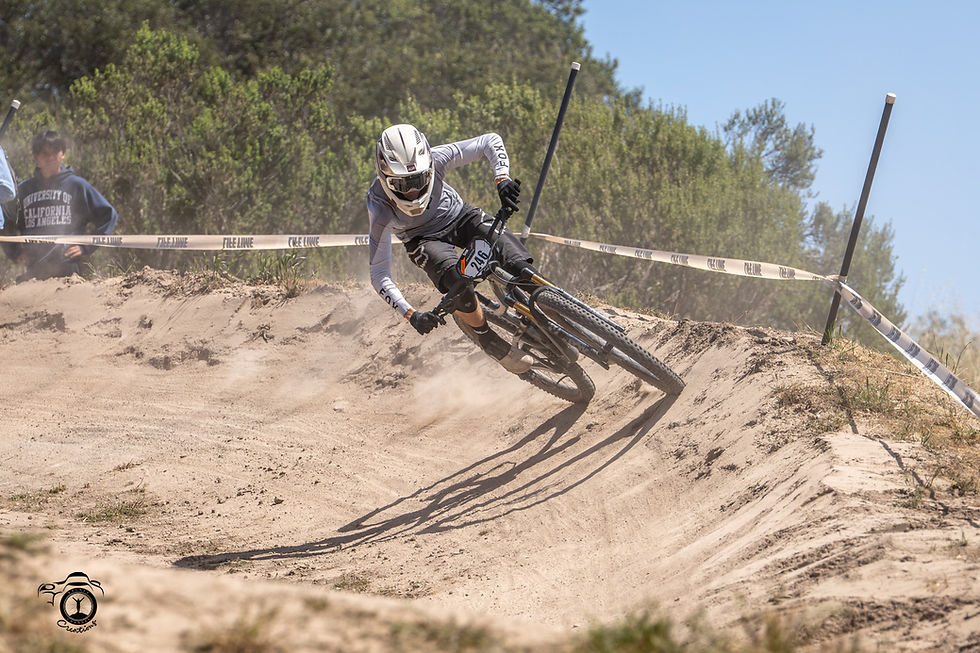
As a photographer, none of this is unusual to me. But combining it with several days of riding - and carrying an A7R III with a 70–200 - changes the equation considerably.
It was probably the first time that day when I really felt the accumulated fatigue.
At the beginning of the morning, I wouldn't have said I was particularly tired.
By now, I was.
And strangely enough, one of the most interesting runs of the entire trip was still ahead.
Undertow - One Run Without Pedaling
Throughout my downhill riding, I've always done one thing almost automatically:
I pedal downhill.
Whenever there is room to add speed, I add speed. If the trail gives me an opportunity to carry more momentum into the next section, I usually take it.
This time I decided to try the exact opposite.
No pedaling.
Not “pedal less.”
None.
I wanted to see what Undertow would feel like if I simply let the terrain and the bike create the speed.
And it turned into a fascinating little experiment.
There were places where my speed dropped almost to nothing. Normally I would have immediately put power into the pedals.
This time I waited.
And the bike began accelerating again.
The trail gave the speed back.
Then it happened again.
Slow down. Wait. Let the terrain work. Build speed again.
Only near the bottom did I finally have to give in and make a couple of pedal strokes to keep moving.
Almost the entire descent had happened without pedaling.
I also had an A7R III and a 70–200 on my back, so this wasn't exactly the moment when I wanted to test how far I could push the limits of traction.
But that probably made the experiment even more interesting.
For once, the goal wasn't to make Undertow faster.
It was to see what happened when I stopped trying to make it faster.
One Trail We Didn't Get to Ride
There was still one trail we never got the chance to ride: NCS.
It had been closed during our stay while the course was being prepared for the upcoming U.S. national championship.
We'd looked at it, talked about it, and knew it was there - but this time, it wasn't ours to ride.
Maybe that's not such a bad way to leave Deer Valley.
There should always be something left for next time.
The End of Five Days
Eventually we washed the bikes and headed for lunch.
At around five in the afternoon.
Which, by this point in the trip, somehow seemed perfectly normal.
Five days in Deer Valley were almost over.
The trails had changed. We had changed. Some sections that looked intimidating at the beginning of the trip had become familiar. Other trails had revealed parts we somehow hadn't even discovered on the first attempt.
There had been long climbs, fast flow trails, rocks, roots, jumps, dry dirt, wind, mechanical problems, a crash of my own and, unfortunately, a much more serious crash for one of our group.
But when I think about Deer Valley as a bike park, all of that exists around one central impression:
I would come back.
Every bike park has its own character. Northstar has one. Mammoth has another.
But after five days here, if I had to choose?
Deer Valley might be my favorite of the three.
Not because every trail is better.
Because of the whole mountain - the variety, the terrain, the length of the riding, and how much there still seemed to be left to explore even after several full days.
We had come here to ride bikes.
Five days later, that still felt like a very good reason to return.

Alexei Bautin
Filmmaker. Photographer. Songwriter.
Some stories need a voice.


Comments